Most Common RNGdle Number
Which number shows up most often in RNGdle? The question hides a subtlety: no single number is more common than another, yet some kinds of rolls happen all the time while others almost never do. This page untangles both halves with the official 233-badge rules, computed across the full range.
What is the most common RNGdle number?
The draw is a discrete uniform distribution: 1,000,001 numbers, each with exactly the same 1-in-a-million chance. So strictly speaking there is no most common RNGdle number — 7 is exactly as likely as 999,993, and yesterday's number is exactly as likely tomorrow as any other. If a site tells you a specific number "comes up more often", it is describing luck, not mechanics.
But categories are a different story. "A number containing a 7" is not one outcome — it is 468,559 of them. Categories can be huge or tiny, and that is where the real most-common answers live. Statisticians make the same move everywhere: no single person is tall, but some height ranges are far more common than others. See discrete uniform distribution for the formal version of the idea.
The most common RNGdle roll types, ranked
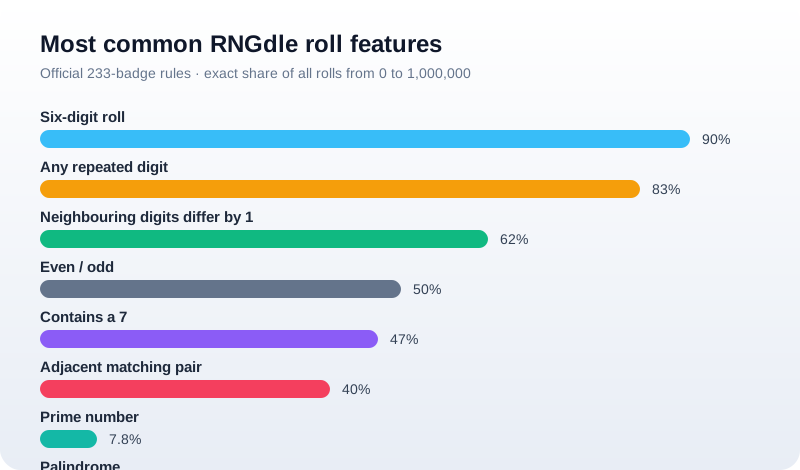
Every share below is the exact hit count of an official badge across all 1,000,001 possible numbers — the same data that sets each badge's EP, since EP is 100 divided by these probabilities:
| Roll type | Share of rolls | Detail |
|---|---|---|
| A six-digit roll (100,000–999,999) | 90% | Nearly every roll is full length. |
| Any digit appearing twice or more | 83% | A single repeated digit is the norm, not the exception. |
| Two adjacent digits differing by 1 | 62% | The Neighbors badge almost always tags along. |
| An even number | 50% | Odds take the other half, to the digit. |
| Contains the digit 7 | 47% | The most common “special” feature; pays almost nothing. |
| An adjacent matching pair (“dd”) | 40% | 4-4, 9-9: two of the same digit side by side. |
| First digit smaller than the last | 40% | So does its mirror, Liftoff. |
| No repeated digits at all | 17% | All-six-different is already mildly special. |
| Divisible by 7 | 14% | Every seventh roll, on the nose. |
| A prime number | 7.8% | The gateway real-math property. |
| Reads the same both ways | 0.20% | Rare enough to screenshot every time. |
Read the top of that table together and the shape of an ordinary day appears: the typical roll is a six-digit number (90%) with a repeated digit somewhere (83%), a lucky 7 or a matching pair keeping it company, and a handful of Common badges paying pocket change. The most common RNGdle number, in the only sense the word has, is exactly that — six digits of respectable ordinariness.
The most common tier — and why that is the design
Card-tier counts make the same point from the grading side: 489,889 of all possible rolls — about 49% — grade Common, and the plainest 10,114 of them (1.0%) sink to Trash. Rare covers another 15%, Epic 5.0%, and Anomaly plus Mythic together barely 5.0%. The ladder is steep on purpose: if special rolls were frequent, screenshots would be meaningless. The rarest-numbers ranking shows the other end of that ladder.
There is a practical upside to knowing the common case. Entropy points accumulate every single day regardless of tier, so a player who shows up daily and collects plain rolls quietly out-earns a lucky visitor who rolled one Epic and disappeared. Commonness is not a punishment — it is the steady drumbeat the whole game runs on, and the baseline that makes every rare day measurable.
The most common RNGdle number is never lucky twice
A warning that belongs on every distribution page: yesterday's most common roll tells you nothing about today's. Each draw is independent and memoryless — the number 7 is not "used up" by appearing, and a week of plain rolls does not make a special one statistically overdue. Gamblers call the opposite belief the gambler's fallacy, and uniform draws are precisely where it burns people.
The practical read is calmer. If your daily roll has been Common for two weeks, that is not a streak to break — it is the ~50% baseline doing its job, and the next draw cares about it exactly as much as the first one did. The most common RNGdle number is common every single day, by design, and no pattern you spot in the history changes its odds by a hair.
The most searched numbers are not the common ones
Culture inverts the math. The numbers people ask about most — 42, 69, 1337, 420420, 777,777 — are precisely the least common outcomes in the range, exact matches worth 100,000,100 EP each. Search interest flows to stories, and stories are scarce by definition: a plain 403,602 has no meme, no history and no fan club, even though it is exactly as likely as 777,777 on any given morning.
That gap between "often discussed" and "often rolled" is the game's charm in one sentence. The common rolls are the stage; the famous numbers are the rare performances on it. If you want to see who actually tops the rarity chart, the best-number ranking is the companion piece to this page, and the worst-number guide covers the quiet majority's floor.
FAQ
What is the single most common RNGdle number?
Trick question: none of them. Each of the 1,000,001 possible numbers has exactly the same 1-in-a-million chance per draw, so no individual number is more common than any other. Commonness belongs to categories and features, not to specific numbers.
What is the most common kind of roll?
A six-digit number with at least one repeated digit and some neighbouring digits that differ by one — 90% of rolls are six digits long, 83% repeat a digit, and 62% have adjacent digits touching in value. The median roll earns a modest Common card tier.
Is the digit 7 really in 47% of numbers?
Yes — 468,559 of the 1,000,001 possible numbers contain at least one 7, which is exactly why the Lucky Seven badge pays only 213 EP. EP is set to 100 divided by the earn probability, so common features are cheap by design.
Does the most common roll type change my strategy?
There is no strategy to change — the draw is uniform and memoryless. Knowing the distribution just calibrates expectations: expect a Common-tier roll about half the time, enjoy anything rarer, and remember that entropy points accrue on every single day, common or not.
How rare is it to beat the most common outcome twice in a row?
For a Rare-or-better card tier (about 15% of the range) twice in a row, multiply the chances: roughly one sequence in 45 two-day spans. Independence does not care how special the first day felt — the second draw starts from scratch.
Keep reading